

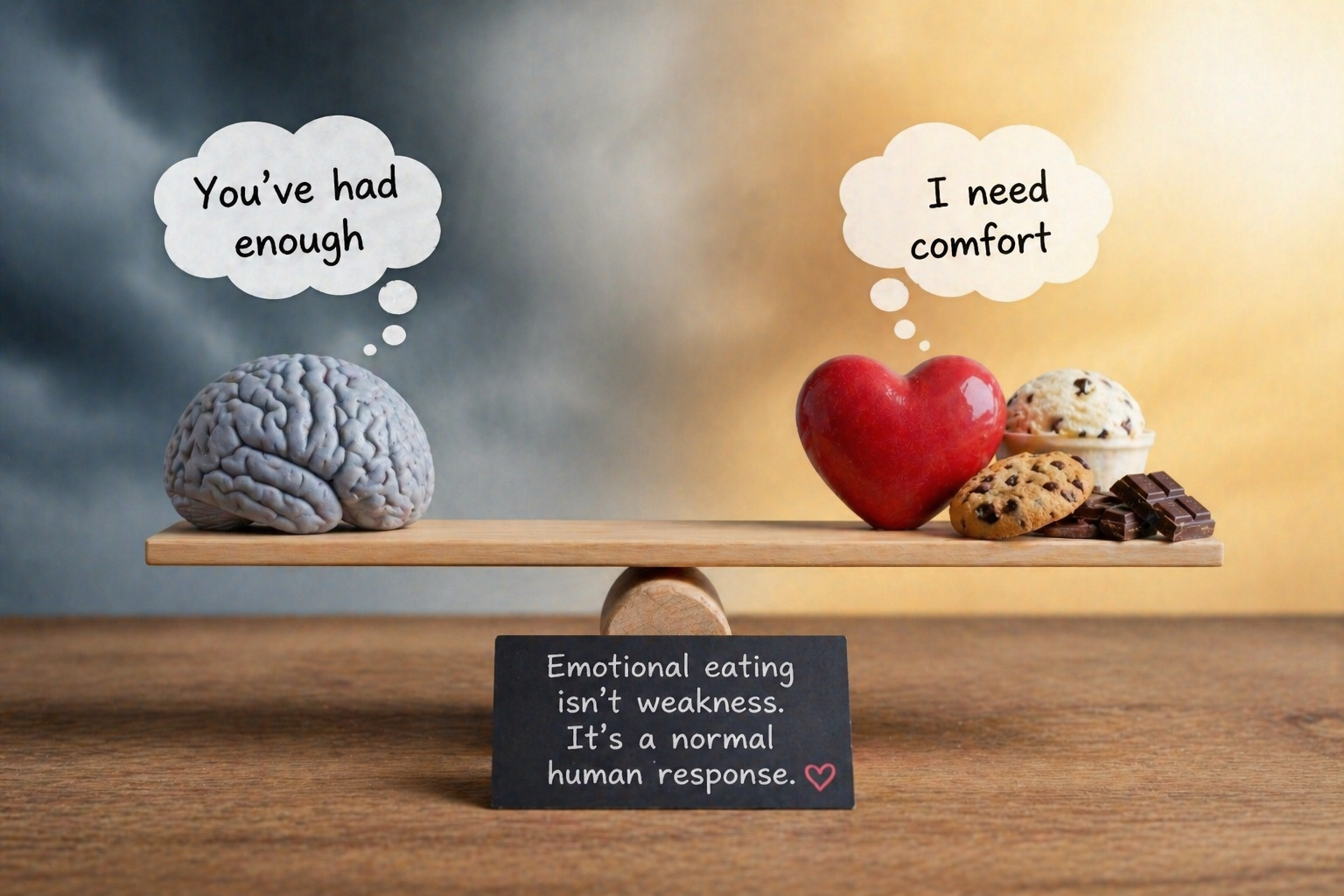
Many people start weight loss medication expecting emotional eating to disappear. Appetite softens, food noise quietens, and early changes can feel reassuring. For a while, it may seem as though eating has finally become neutral and uncomplicated. Then, often unexpectedly, emotional eating shows up again. When it does, it can feel confusing or even discouraging.
It is important to say this clearly from the outset. Emotional eating returning does not mean the medication has stopped working. It does not mean you have failed, regressed, or lost control. It means you are human.
Emotional eating is not only about hunger. It is often tied to comfort, habit, relief, distraction, or familiarity. These patterns tend to form over years, sometimes decades. Medication can quiet appetite, but it does not erase emotional associations with food or the role eating has played during stress, loneliness, boredom, or overwhelm. When life feels tough, those associations can still be activated.
For some people, emotional eating looks obvious. Eating when upset. Reaching for food after a difficult conversation. For others, it is less obvious. Snacking without much awareness. Wanting something specific without being hungry. Eating past fullness, not because the food tastes particularly good, but because there is a pull to keep going. On weight loss medication, these moments can stand out more sharply because they contrast with how eating feels the rest of the time.
This can lead to a sense of alarm. Many people start to worry that something has gone wrong. They may assume emotional eating should no longer exist now that appetite is reduced. In reality, what is happening is often the opposite. The quieter background of less appetite makes the emotions underneath easier to notice. Without constant hunger driving eating, the emotional reasons become more visible.
Stress plays a significant role here too. On demanding days, our emotional bank account is stretched. Food has often served as a reliable pause in the day or a moment of comfort. Even if hunger is low, our body and mind may still reach for what has historically helped take the edge off. This is not a flaw in character. It is a learned response that once served a purpose.
There is also an adjustment period with weight loss medication. Eating can become less rewarding in the usual ways. When pleasure from food is reduced, people sometimes seek familiar emotional responses rather than physical satisfaction. This can look like eating for texture, routine, or reassurance rather than taste or hunger. Again, this is not something to correct or suppress. It is information.
A common reaction is to try to shut emotional eating down as soon as it appears. People may tell themselves they should not be doing this anymore. They may label the moment as a problem that needs fixing. This tends to increase tension rather than reduce it. Emotional eating often becomes more persistent when it is met with judgement or urgency.
It can be more helpful to notice what emotional eating looks like for you now, rather than what you think it should look like. On medication, it may be smaller in volume, less frequent, or less intense than before. That matters. Emotional eating does not have to be eliminated to be changing. Often, it is already shifting in quieter ways.
It is also worth recognising that emotional eating is not always about negative feelings. It can show up during tiredness, celebration, comfort-seeking, or the need for grounding. Trying to categorise it as “good” or “bad” usually oversimplifies something that is more complicated than that. For many people, food has been one of the few consistent forms of self-soothing available. Letting go of that role takes time.
There is also a practical nutrition side. Emotional eating can be stronger when the body has had too little food across the day. If meals have been missed because appetite is low, the evening urge for food may be part emotion and part under-fuelling. It is worth checking both.
Over time on weight loss medication, emotional eating often becomes less automatic. There may be a pause where previously there was none. You might notice the urge without immediately acting on it, or act on it and stop sooner than before. These moments are easy to overlook, but they reflect meaningful change.
If emotional eating begins to feel distressing, frequent, or accompanied by shame or secrecy, that is worth exploring further. Not because it should not be happening, but because it may be signalling unmet emotional needs, sustained stress, or unrealistic expectations of what medication can do on its own. Support at that point is not about control. It is about understanding.
If you would like to talk this through in more detail, you can book time with a member of the Synergy BMI team by following the links on our homepage.
Emotional eating showing up does not cancel progress. Weight loss treatment is not about getting to a point where you have no emotions around food. It is about creating space to respond differently over time. Some days will still be messy. Some moments will still be familiar. That does not mean you are back where you started.
If you find yourself surprised by emotional eating while on medication, the most useful question is often not “Why am I still doing this?” but “What is going on for me right now?” That shift alone can reduce a great deal of unnecessary pressure we put on ourselves.
Educational content only. This article does not replace medical advice. If side effects persist, worsen, or cause concern, speak with your prescriber.
© Synergy Wellness Limited trading as Synergy BMI. All rights reserved. This content may not be reproduced, distributed, or shared without prior written permission.